New Simulations Suggest Rapid Formation of the Moon
Recent research indicates that the Moon may have formed within hours after a colossal collision between Earth and a protoplanet.
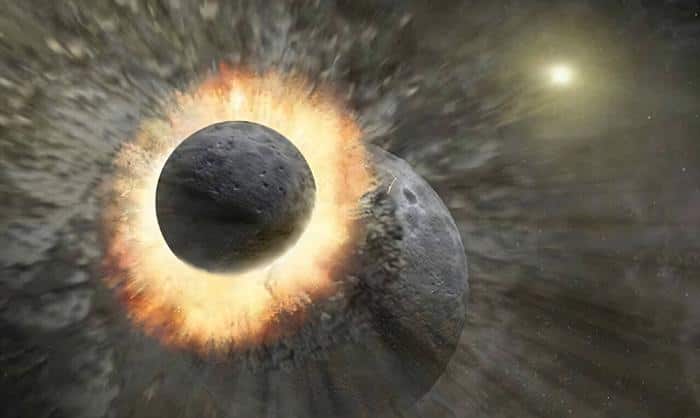
The Moon's formation is linked to a collision with a Mars-sized body called Theia.
New simulations propose that the Moon could have taken shape within five hours post-collision.
Understanding the Moon's rapid formation could shed light on the early conditions of Earth and Theia.
Recent research has unveiled that the Moon's formation might have occurred much faster than previously thought, potentially within just five hours following a catastrophic impact with a Mars-sized protoplanet named Theia. This groundbreaking insight comes from a series of computer simulations conducted by a team led by planetary scientist Adeene Denton from the Southwest Research Institute, in collaboration with researchers from the University of Arizona.
The prevailing theory suggests that around 4.5 billion years ago, the young Earth was struck by Theia, resulting in a violent collision that ejected debris into orbit around Earth. Traditionally, it was believed that this debris gradually coalesced under gravitational forces to form the Moon. However, the new research challenges this notion, suggesting that the process could have been significantly quicker, depending on the temperature and material strength of the colliding bodies.
The simulations incorporated a critical factor that previous models largely overlooked: the strength of the rocks at the moment of impact. The researchers found that a hotter planet, like the early Earth, would have weaker rocks that deform more easily, allowing for a faster formation of a coherent Moon-sized body. In one of the simulations, the results indicated that the Moon could have formed within five hours of the collision, although this does not imply that it reached its current state of development in that time frame.
This research holds significant implications for our understanding of both the Moon and Earth. If the Moon's formation was indeed rapid, it suggests that its early characteristics were closely tied to the conditions of the two planetary bodies at the time of impact. This could help scientists reverse-engineer the Moon's current properties to glean insights into the conditions during the giant impact. Furthermore, the study addresses a long-standing enigma regarding the compositional similarities between Earth and the Moon, although it does not fully resolve this mystery.
As scientists continue to explore the origins of the Moon, the findings from this study contribute to a growing body of evidence suggesting that the Moon's birth was a swift and violent event. The implications of this research extend beyond lunar studies, potentially reshaping our understanding of planetary formation and evolution in the early Solar System. The study titled "Collisional Capture of an Intact Moon Depends on Strength" was published in The Astrophysical Journal Letters on September 1, 2026.


